
 Search

Credit: OpenAI
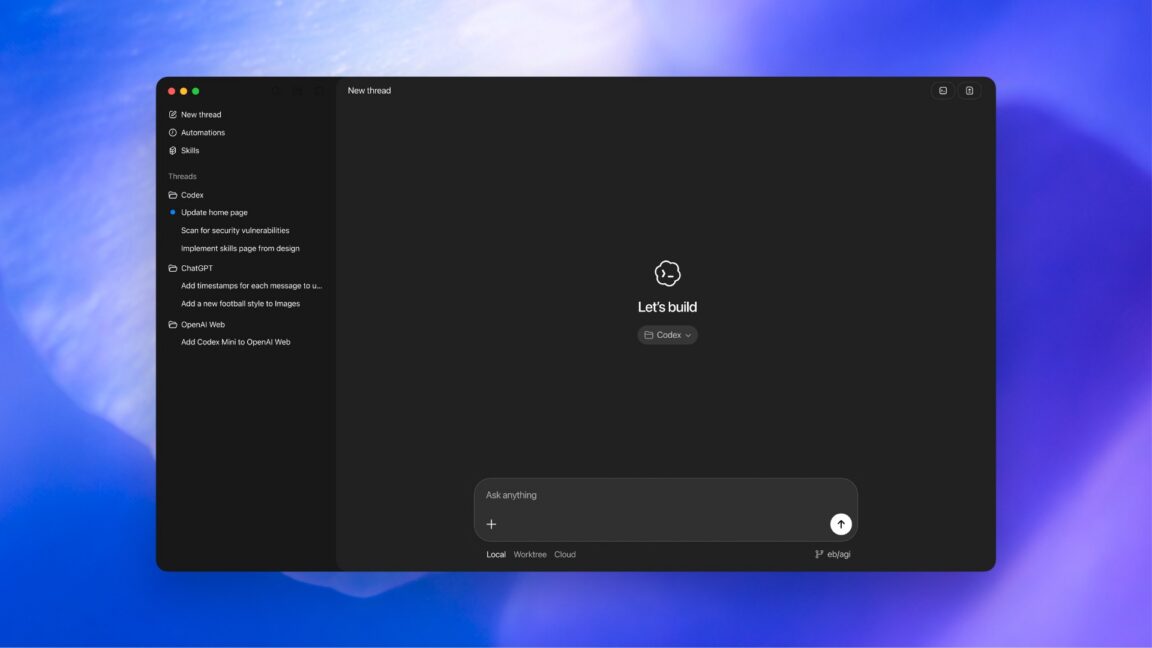
Today, OpenAI launched a macOS desktop app for Codex, its large language model-based coding tool that was previously used through a command line interface (CLI) on the web or inside an integrated development environment (IDE) via extensions.
By launching a desktop app, OpenAI is catching up to Anthropic’s popular Claude Code, which already offered a macOS version. Whether the desktop app makes sense compared to the existing interfaces depends a little bit on who you are and how you intend to use it.
The Codex macOS app aims to make it easier to manage multiple coding agents in tandem, sometimes with parallel tasks running over several hours—the company argues that neither the CLI nor the IDE extensions are ideal interfaces for that.
Agents are grouped by project, so users can work on more than one project at once, too. As with other comparable tools, Codex agents support worktrees to help avoid conflicts.
Skills—basically extensions in the form of folders filled with instructions and other resources—are also supported. The app lets users configure Automations, which follow instructions on a user-set schedule, with Skills support.
Based on my time using Codex, it seems capable, even though OpenAI has been running a few months behind Anthropic on the product side. To help bridge the gap, OpenAI is using a strategy it has used before: higher usage limits at a similar cost.
As of today, Codex rate limits are doubling on Plus, Pro, Business, Enterprise, and Edu plans, OpenAI announced. It’s also offering Codex to ChatGPT Free and Go subscribers “for a limited time,” though the announcement didn’t clarify what the rate limits look like there.

-
 C114 Communication Network
 -
 Communication Home
