
 Search

Credit: Malte Mueller via Getty Images
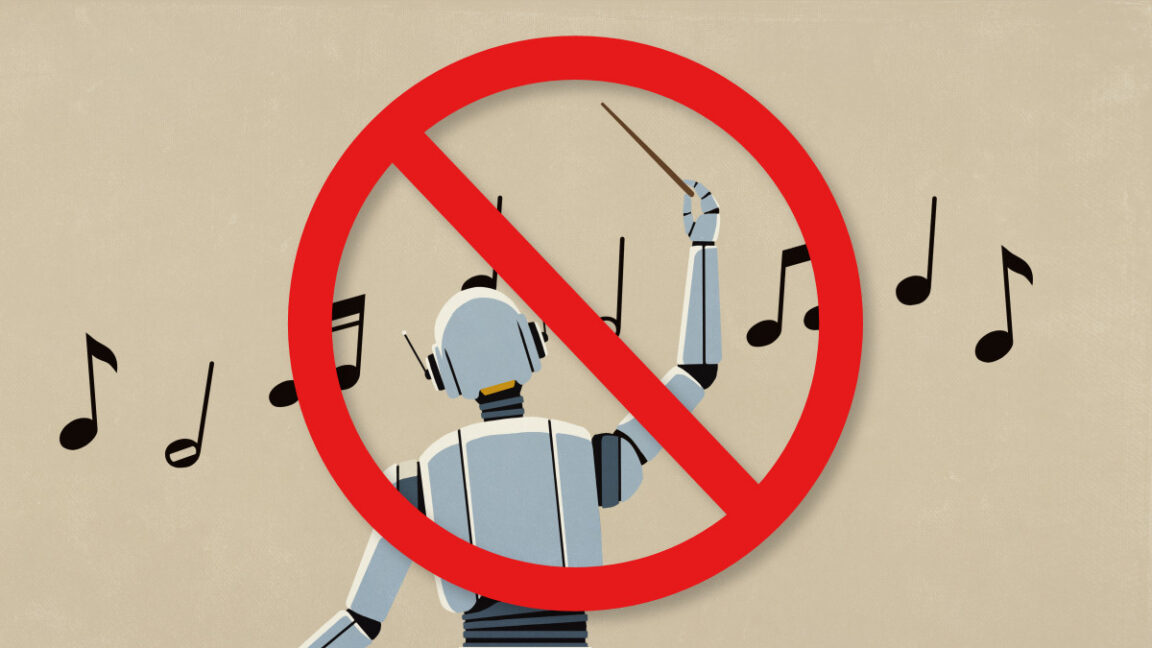
On Tuesday, Bandcamp announced on Reddit that it will no longer permit AI-generated music on its platform. “Music and audio that is generated wholly or in substantial part by AI is not permitted on Bandcamp,” the company wrote in a post to the r/bandcamp subreddit. The new policy also prohibits “any use of AI tools to impersonate other artists or styles.”
The policy draws a line that some in the music community have debated: Where does tool use end and full automation begin? AI models are not artists in themselves, since they lack personhood and creative intent. But people do use AI tools to make music, and the spectrum runs from using AI for minor assistance (cleaning up audio, suggesting chord progressions) to typing a prompt and letting a model generate an entire track. Bandcamp’s policy targets the latter end of that spectrum while leaving room for human artists who incorporate AI tools into a larger creative process.
The announcement emphasized the platform’s desire to protect its community of human artists. “The fact that Bandcamp is home to such a vibrant community of real people making incredible music is something we want to protect and maintain,” the company wrote. Bandcamp asked users to flag suspected AI-generated content through its reporting tools, and the company said it reserves “the right to remove any music on suspicion of being AI generated.”
As generative AI tools make it trivial to produce unlimited quantities of music, art, and text, this author once argued that platforms may need to actively preserve spaces for human expression rather than let them drown in machine-generated output. Bandcamp’s decision seems to move in that direction, but it also leaves room for platforms like Suno, which primarily host AI-generated music.
Two platforms, two approaches, one flood
The policy contrasts with Spotify, which explicitly permits AI-generated music, although its users have expressed frustration with an influx of AI-generated tracks created by tools like Suno and Udio. Some of those AI music issues predate the latest tools, however. In 2023, Spotify removed tens of thousands of AI-generated songs from distributor Boomy after discovering evidence of artificial streaming fraud, but the flood just kept coming.
Last September, Spotify revealed that it had removed 75 million spam tracks over the previous year. It’s a figure that rivals the scale of Spotify’s actual catalog of 100 million tracks. Country music has also been particularly affected by AI music synthesis on Spotify, with AI-generated tracks sometimes topping genre charts above fully human tracks in December 2025.
In a newsroom post from last year, Spotify wrote that it envisioned “a future where artists and producers are in control of how or if they incorporate AI into their creative processes” and that the company wants to leave “those creative decisions to artists themselves.” Spotify focuses its enforcement on impersonation, spam, and deception rather than banning AI-generated content outright.
In some ways, the stark contrast between Bandcamp and Spotify reflects their different business models. Bandcamp operates as a direct marketplace where artists sell music and merchandise to fans, taking a cut of each sale. Spotify pays artists per stream, creating incentives for bad actors to flood the platform with cheap AI content and game the algorithm.
Bandcamp acknowledged the policy may evolve. “We will be sure to communicate any updates to the policy as the rapidly changing generative AI space develops,” the company wrote. The announcement also noted that the company had received feedback about this issue previously, writing, “Given the response around this to our previous posts, we hope this news is welcomed.”
Enforcement remains a question. Detecting AI-generated music is not straightforward, since today’s products of AI synthesis realistically imitate voices and even acoustic instruments. Bandcamp did not specify what tools or methods it would use to identify AI content, only that its team would review flagged submissions. In a world where seemingly unlimited quantities of music can now be created at the push of a button, that’s no minor task.

-
 C114 Communication Network
 -
 Communication Home
